
Rational Reaction: Iran, Oil, and Your Portfolio
As you have seen in the news, the U.S. and Israel have launched strikes against Iran, targeting leadership, military assets, and nuclear infrastructure. Iran has retaliated with attacks across the Middle East.
The situation continues to evolve, and the safety of civilians in the region and our troops remains the most important consideration. That said, we also believe it’s important to look at the financial market implications to provide perspective on what this means for markets, oil prices, and your portfolio.
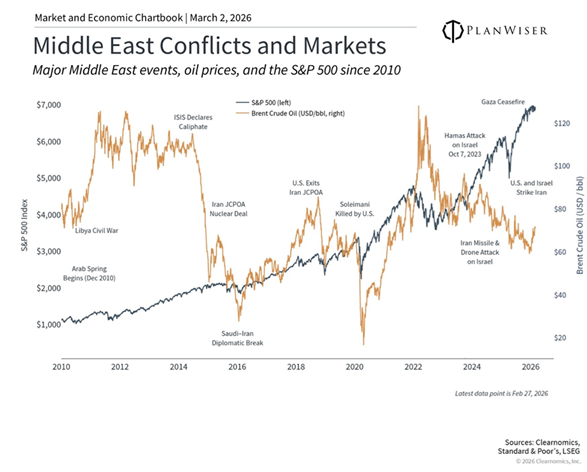
These strikes are the latest chapter in an ongoing story
Following the strikes, oil prices increased, pushing stocks and bonds lower. This is consistent with other Middle East conflicts, where oil price spikes are often a primary driver of market moves.
The scope of the latest strikes is broader than previous engagements. However, history also makes it clear that these conflicts are not always a catalyst for lasting market movements. After all, there have been many Middle East conflicts over the past few years, and oil prices are still well below their 2022 peaks.
While the scale of the current strikes is significant, tensions between the U.S., Israel, and Iran have been escalating for some time. This latest development follows a month-long U.S. military buildup in the region and failed negotiations over Iran's nuclear program.
Looking from a broader perspective, from World War II to the Gulf War, markets often experienced short-term volatility but were driven by economic fundamentals over the long run. More recently, conflicts between Russia and Ukraine, and between Israel and Hamas, created uncertainty but did not derail the long-term market trajectory.
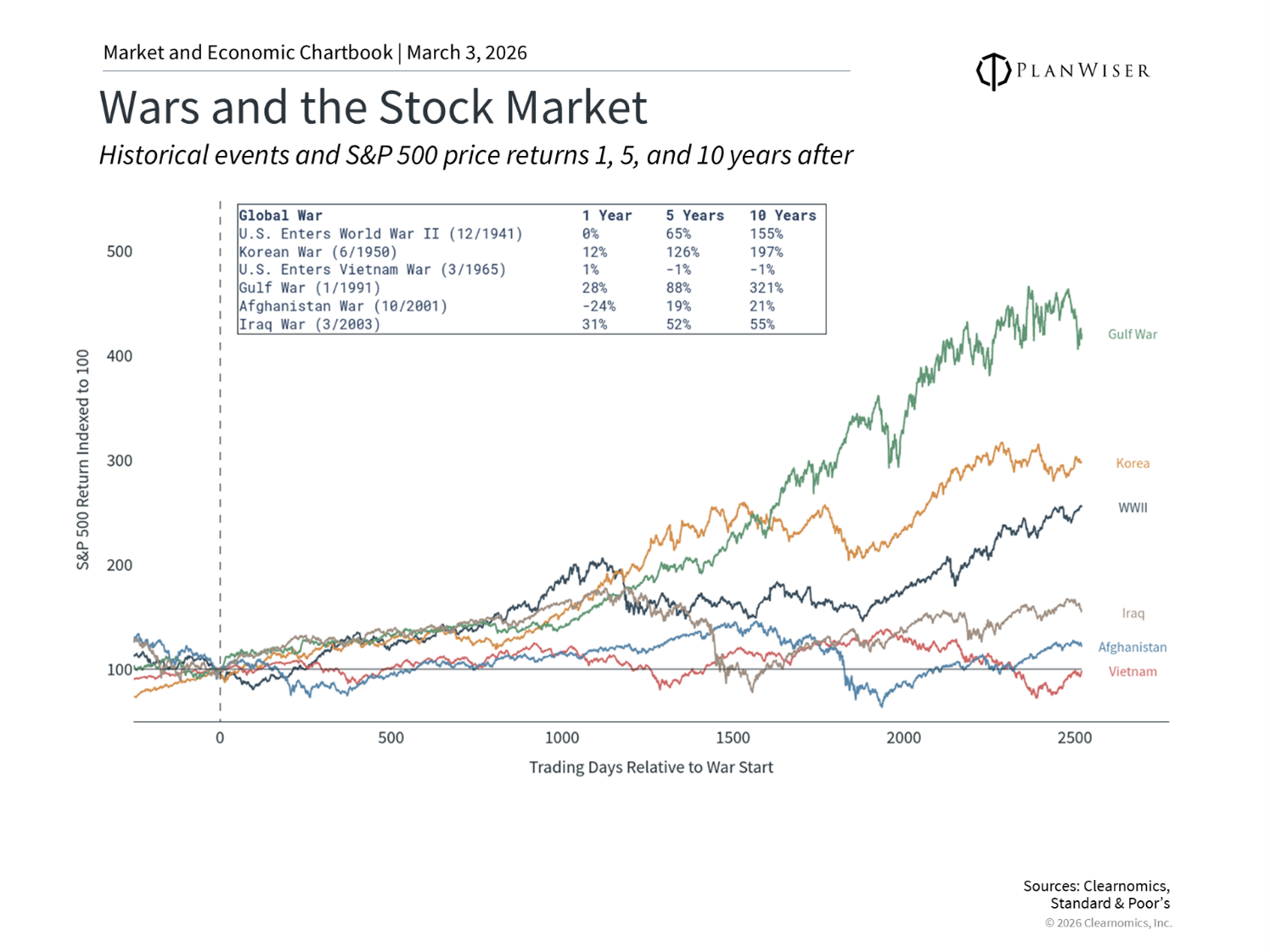
PlanWiser’s process of building a portfolio and creating financial plans is designed precisely to manage this uncertainty. While each event is unique, financial markets have navigated countless
wars, crises, and regional conflicts.
Oil prices and the Strait of Hormuz
For investors, the most direct way that Middle East conflicts affect financial markets is through oil prices and global trade. Iran sits along the Strait of Hormuz, the world's most critical energy waterway.
A key question is whether Iran has the means or willingness to cause long-lasting disruption to the Strait of Hormuz, as this could have implications for global energy markets. Oil prices had already been rising in anticipation of the strikes.
However, perspective is needed. Current oil prices remain far below the 2022 peak of nearly $128 per
barrel when Russia invaded Ukraine. The U.S. is also now the world's largest producer of oil and natural gas. While the U.S. still relies on global energy markets, this level of production helps insulate the domestic economy from supply disruptions.
Staying invested but opportunistically looking to adjust to data
For long-term investors, the most important lesson from past geopolitical conflicts is the value of staying invested. It's natural to feel uneasy when headlines describe military strikes and the possibility of a wider regional war. These events involve real human consequences and are unlike typical market news about earnings and economic data.
It's also important to note that Iran plays a minimal direct role in most investment portfolios. The country has been under heavy sanctions for years, limiting its participation in global financial markets. The indirect effects through oil prices and broader uncertainty are more relevant than any direct exposure.
This does not imply that markets will be free from volatility in the days and weeks ahead. Ongoing uncertainty regarding the duration and scope of the conflict may continue to influence investor sentiment. However, periods of volatility often present compelling opportunities. Accordingly, clients should not be surprised to see adjustments within their portfolios if our research-driven analysis indicates that such changes would improve their probability of achieving long-term success.
Disclosures
PlanWiser and Clearnomics are unaffiliated entities.
Copyright (c) 2026 Clearnomics, Inc. All rights reserved. The information contained herein has been obtained from sources believed to be reliable, but is not necessarily complete and its accuracy cannot be guaranteed. No representation or warranty, express or implied, is made as to the fairness, accuracy, completeness, or correctness of the information and opinions contained herein. The views and the other information provided are subject to change without notice. All reports posted on or via www.clearnomics.com or any affiliated websites, applications, or services are issued without regard to the specific investment objectives, financial situation, or particular needs of any specific recipient and are not to be construed as a solicitation or an offer to buy or sell any securities or related financial instruments. Past performance is not necessarily a guide to future results. Company fundamentals and earnings may be mentioned occasionally, but should not be construed as a recommendation to buy, sell, or hold the company's stock. Predictions, forecasts, and estimates for any and all markets should not be construed as recommendations to buy, sell, or hold any security--including mutual funds, futures contracts, and exchange traded funds, or any similar instruments. The text, images, and other materials contained or displayed in this report are proprietary to Clearnomics, Inc. and constitute valuable intellectual property. All unauthorized reproduction or other use of material from Clearnomics, Inc. shall be deemed willful infringement(s) of this copyright and other proprietary and intellectual property rights, including but not limited to, rights of privacy. Clearnomics, Inc. expressly reserves all rights in connection with its intellectual property, including without limitation the right to block the transfer of its products and services and/or to track usage thereof, through electronic tracking technology, and all other lawful means, now known or hereafter devised. Clearnomics, Inc. reserves the right, without further notice, to pursue to the fullest extent allowed by the law any and all criminal and civil remedies for the violation of its rights.