
Rational Reaction: Understanding the AI Investment Landscape
You have no doubt seen all of the headlines about AI investments, new large language models, and the companies behind them. At PlanWiser, we want to help you step back from the daily news and understand the bigger picture: not just what AI is today, but how its impact is likely to unfold over the coming years, and why history suggests this kind of shift tends to produce clear winners and clear losers.
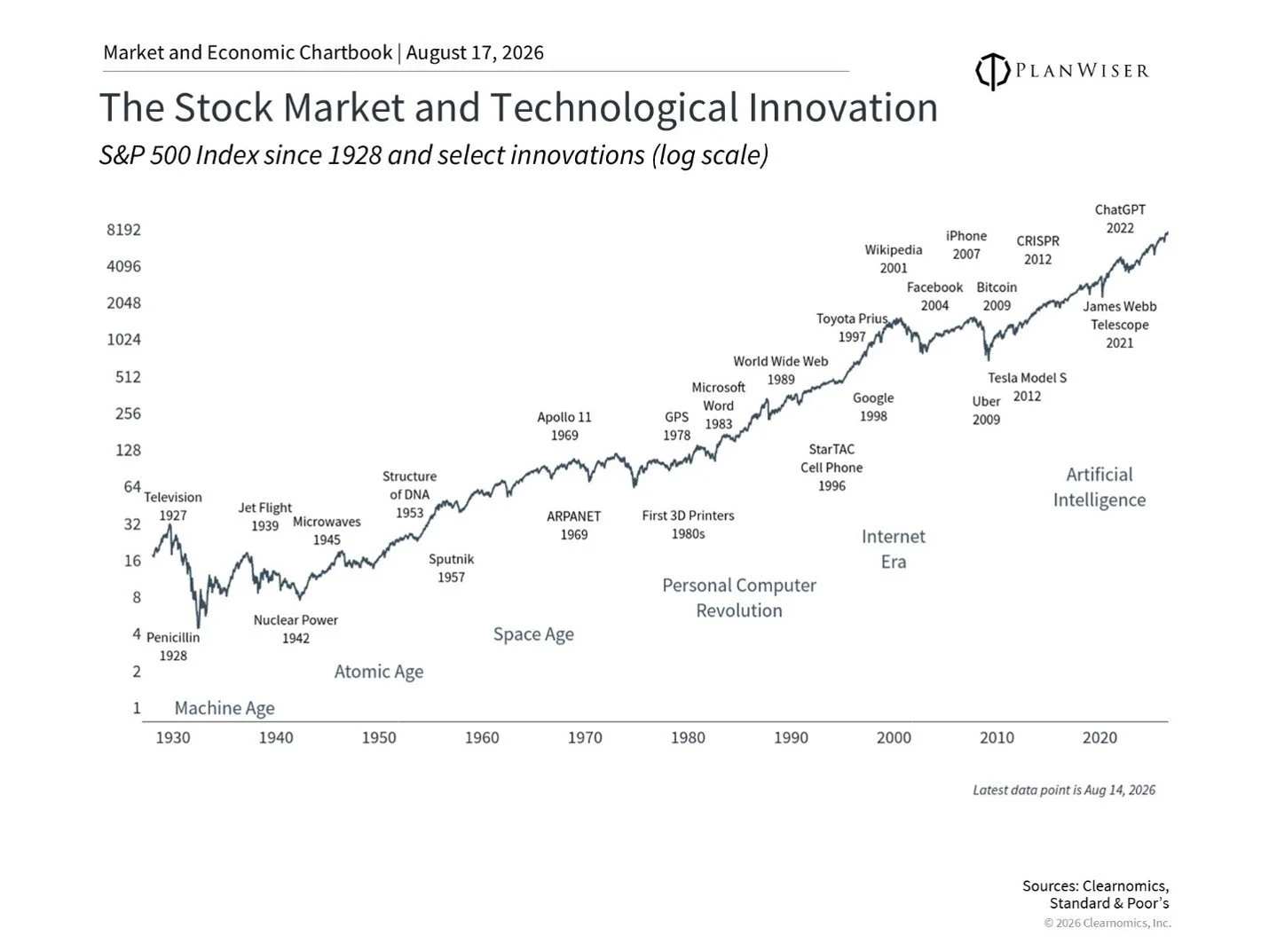
The key fact is that AI is not just about chatbots or a few stocks. Instead, a broad set of industries, business models, and investment opportunities make these capabilities possible, and that set will keep changing as companies figure out how to actually use the technology. We have seen this pattern before. The railroads, the electrification of American industry, and the build-out of the internet in the 1990s all began with a wave of infrastructure spending concentrated in a handful of companies, and all took years, sometimes decades, before the real economic payoff showed up broadly across the economy. In each case, some early leaders became lasting winners, others faded, and the full impact was felt only gradually.
Understanding the most important parts of the AI value chain
When most people think about AI investing, they think about companies like Google, OpenAI, Anthropic, and others. These are the firms building the large language models that power tools like Gemini, ChatGPT, and Claude. But they represent only one piece of a much larger puzzle.
At the foundation is semiconductor hardware, including GPUs and memory chips, which are needed both to train AI models and to run them. Training a large AI model requires thousands of connected servers working together for months. Running these models requires computing resources every single time someone enters a prompt. This is why demand for specialized chips has grown so dramatically.
These chips are housed in data centers, which are essentially warehouses filled with servers that run around the clock. They require significant amounts of electricity, cooling systems (including water), and physical infrastructure. Spending on data center construction has surged, contributing to overall economic activity.
Finally, and in our view most importantly over time, there are the businesses and software providers that are putting AI to work. This includes AI-powered applications sold directly to customers, as well as companies across every industry using AI internally to cut costs, speed up processes, or offer new products. This layer is the hardest to evaluate today, because the payoff shows up gradually rather than all at once. A company that adopts AI well this year may not show meaningfully better earnings for several years, as it works through the same trial-and-error that companies went through when they first wired their factories for electricity or first put computers on every desk. This is also where the winners and losers of this era will ultimately be decided. The businesses that adapt fastest and most effectively should pull ahead of competitors that adopt AI too slowly or too poorly, and that gap is likely to widen over time rather than close.
How will AI impact investors?
One of the central questions in markets today is whether the enormous sums being invested in AI infrastructure will eventually generate sufficient returns. The largest technology companies are spending hundreds of billions of dollars building out data centers and computing capacity, much as railroad companies once poured capital into track and utilities once poured capital into power plants and transmission lines, long before most of the economy had found a use for what they were building. This has led to volatility in AI-related stocks over the past year, as investors have shifted back and forth between optimism about growth and concerns about whether demand will keep pace. Every prior wave of major innovation has produced big winners and big losers along the way, and there is little reason to expect this one will be different.
History tells us that even when a trend is real, it often takes time for it to play out. After all, today’s megacap tech companies have taken thirty years or more to get to where they are today, and it took roughly two decades after electricity reached American factories before productivity statistics showed the gains, once companies had actually redesigned their operations around it rather than simply bolting it onto old ways of working. In the meantime, markets can overestimate how quickly new technologies translate into profits, and they can just as easily underestimate how large the eventual gap becomes between companies that adapt well and those that do not. Perspective and portfolio balance are important virtues in scenarios like these.
As AI has captured investor attention, valuations across technology-related sectors have risen steadily. It is worth noting that these higher valuations reflect strong earnings growth for many of these companies as well. The Information Technology sector currently trades at elevated levels relative to its own history and relative to the broader market. Other sectors containing large technology companies, including Communication Services and Consumer Discretionary, show similar patterns, reflecting expectations about future profitability.
Your portfolio is designed with all of these considerations in mind. It provides participation in the growth potential of technology and AI-related industries while also maintaining exposure to areas of the market that offer stability and value. This kind of balance is what allows investors to stay on track through the inevitable periods of market volatility that come with any major technological shift.
The most important thing to remember is that your long-term financial goals, whether that means a comfortable retirement, providing for your family, growing a business, or building lasting wealth, should not change based on any single market trend.