

Tax Planning Philosophy
The Hidden Drag on Wealth
Why Tax Planning Is a Key to Financial Planning
At PlanWiser, we believe financial planning is about much more than growing wealth. It is about helping families keep more of what they earn, preserve more of what they build, and make smarter decisions across every stage of life. That is why tax planning is not a separate or annual exercise that begins in March and ends on April 15. Tax planning is one of the foundational pillars of comprehensive financial planning.
After all, every major financial decision has tax consequences. Whether you are deciding when to retire, how to claim Social Security, whether to convert assets to a Roth IRA, how to manage real estate transactions, how to invest taxable assets, when to sell a business, how to pass wealth to the next generation, or how to structure charitable gifts—taxes affect the outcome.
The question is not whether taxes matter. The question is whether they are being planned for proactively.
The Return You Keep Matters More Than the Return You Earn
For decades, the wealth management industry has measured success by one primary metric: investment returns.
Markets go up.
Markets go down.
Benchmarks are compared.
Portfolios are ranked.
Investment management is important—and at PlanWiser, we believe in disciplined, evidence-based investing designed to help clients achieve strong long-term returns. But we also believe the industry has spent too much time asking the wrong question.
The better question isn't: "How much did your portfolio earn?"
It's: "How much of that wealth did you actually keep?"
Financial planning researcher William Reichenstein has long argued that investors should think in terms of after-tax wealth, not account balances. His work highlights a reality many investors overlook: $100,000 in a Roth IRA is not the same as $100,000 in a traditional IRA because the future tax obligations are dramatically different.
The same principle applies throughout a financial plan. Two families with identical investment returns can experience very different outcomes depending on how effectively they manage taxes.
The Hidden Cost of Taxes
A study by Columbia University professor Andrew Ang examined the impact of federal taxes on stock market investors over the past century. His findings were striking.
After simulating a taxable investor owning the broad U.S. stock market from 1926 through 2025, Ang found that federal taxes reduced long-term equity wealth by more than one-third across different 30-year periods. Ang states his conclusion clearly. "Federal taxes alone consume roughly one-third of the nominal pre-tax return before state taxes, fees, or inflation."
For many families, taxes represent one of the largest ongoing expenses they will ever face. Yet they often receive far less attention than investment performance.
Advisor Value Often Comes from Tax Planning
Research from Vanguard has reached a similar conclusion. In its well-known "Advisor's Alpha" framework, Vanguard identified tax-efficient investing, asset location, withdrawal sequencing, and other tax-sensitive strategies as meaningful contributors to advisor value.
Morningstar researchers David Blanchett and Paul Kaplan reached a comparable conclusion in their groundbreaking research on "Gamma." Their work demonstrated that many of the most valuable planning decisions have little to do with selecting investments and much more to do with optimizing financial decisions, including:
Tax-efficient withdrawal strategies
Roth conversion planning
Social Security coordination
Real estate transaction optimization
Asset location decisions
Retirement income sequencing
In other words, financial planning value often comes not from beating the market but from making better decisions around taxes, retirement income, and wealth preservation.
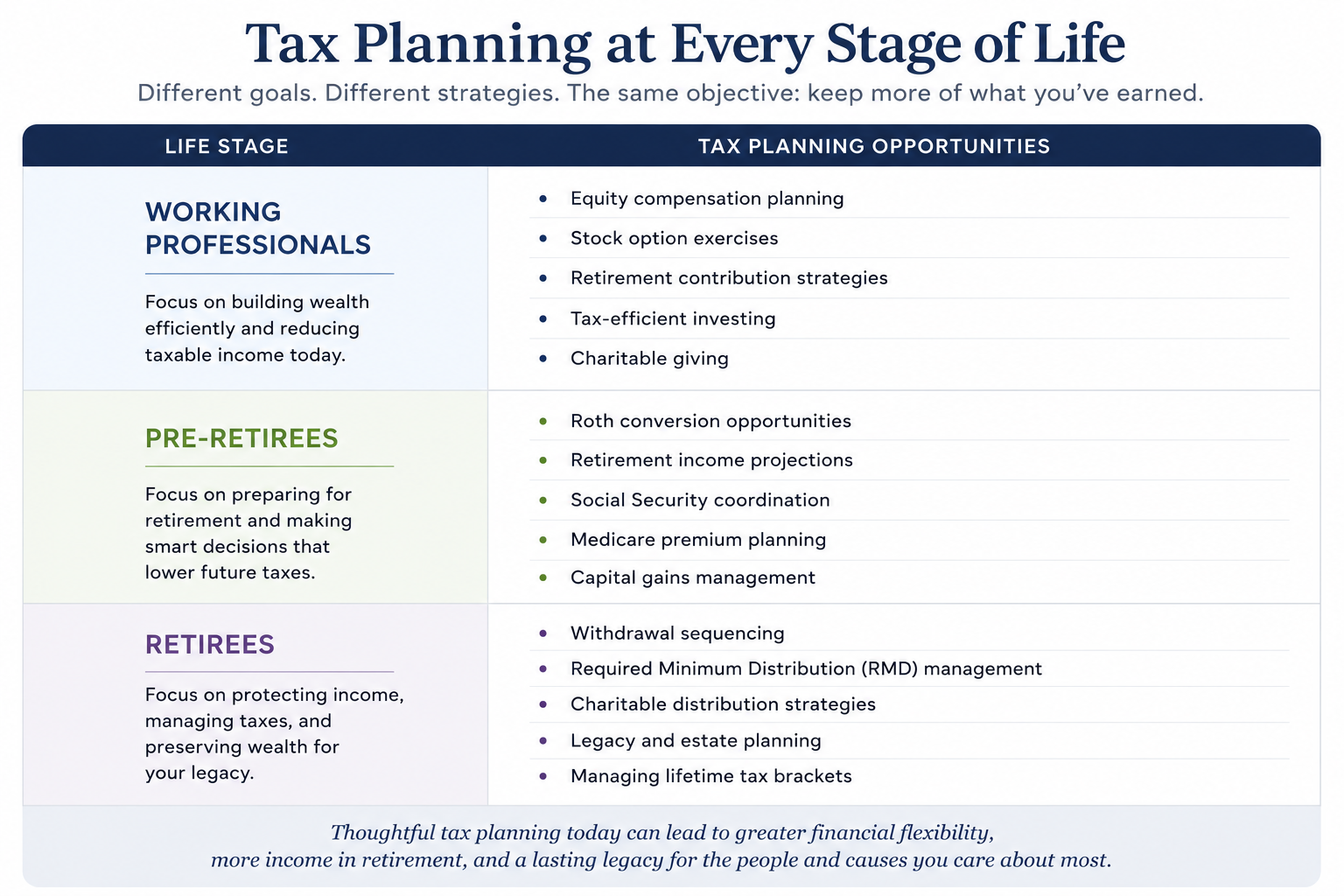
Taxes Affect Every Stage of Life
Tax planning is not just a retirement strategy.
Every stage presents opportunities to reduce taxes, improve cash flow, and increase long-term after-tax wealth.
Think in Lifetime Taxes, Not This Year's Tax Return
Many people think tax planning means finding deductions. We think tax planning means managing lifetime tax exposure.
The most important planning question is often not: "What can I deduct this year?"
Instead, it is: "How can we reduce the total taxes you pay over the rest of your life?"
Sometimes that means recognizing income earlier.
Sometimes it means delaying income.
Sometimes it means harvesting gains.
Sometimes it means harvesting losses.
Sometimes it means paying taxes intentionally today to avoid much larger taxes later.
The answer depends on the client's circumstances, goals, and future expectations.
Our Philosophy at PlanWiser
At PlanWiser, we believe the best financial decisions are made through an after-tax lens. We do not view tax planning as a separate specialty that exists alongside financial planning. We view it as an essential component of every recommendation we make.
When evaluating investment strategies, retirement income plans, Roth conversions, real estate transaction, charitable giving opportunities, estate planning decisions, or business transitions, we ask a simple question:
“How does this affect the client's after-tax outcome?”
Because ultimately, clients do not spend pre-tax returns; they spend after-tax dollars.
And in our experience, lasting financial success comes from optimizing every lever within a financial plan—not just investment returns. Disciplined investing, thoughtful tax planning, retirement income planning, estate planning, and other strategic decisions all work together to create better long-term outcomes. Strong returns matter, but so does keeping more of what those returns create.
References
Andrew Ang, Uncle Sam's Cut: A Century of the Federal Tax Drag on U.S. Equity Returns (2026)
Vanguard, Putting a Value on Your Value / Advisor's Alpha
David Blanchett & Paul Kaplan, Morningstar, Alpha, Beta, and Now... Gamma
William Reichenstein, retirement income and after-tax wealth research
Michael Kitces, tax-efficient retirement income and withdrawal planning research